AI Agent
Services
AI agents are moving from experiments to operating infrastructure. High Peak Software helps teams design, build, and deploy agentic systems that execute tasks, use enterprise tools safely, and coordinate across workflows.
Build Agents That Ship
This is not a chatbot project. It is a delivery program for autonomous workflows, human review, and measurable business outcomes in organizations where direct engagement with AI agents is becoming part of everyday work.
With task-specific AI agents expected in 40 percent of enterprise applications by the end of 2026, the advantage goes to companies that get production architecture right.
High Peak Software helps teams design, build, and deploy agentic systems that execute tasks, use enterprise tools safely, and coordinate across workflows with governance built in from day one.


Use Case Discovery
We design conversational AI for customer service across phone, web, mobile, and messaging, so customers can resolve common intents without waiting for an agent.

Agent Architecture Design
Our systems monitor intent, sentiment, authentication state, and urgency in real time, then escalate edge cases to the right team with full conversation context.

Enterprise Integration Layer
We orchestrate the AI agent workflow behind every interaction, from retrieval and policy checks to CRM updates, ticket creation, summaries, and follow-up actions.

Multi Agent Orchestration
High Peak connects conversational layers to telephony, CRMs, knowledge bases, identity, case management, and legacy platforms, without forcing a risky rip-and-replace program.

Evaluation and Governance
We build guardrails for regulated environments, including audit trails, fallback logic, prompt controls, analytics, and human review paths for high-risk decisions.

Deployment and Optimization
After launch, we tune containment, deflection, transfer quality, handle time, and customer outcomes using real transcripts, intent drift analysis, and ongoing model evaluation.
Customer stories
From finance automation to healthcare operations, High Peak helps teams turn AI plans into shipped systems and measurable process gains.

How a Fintech Analytics Provider Scaled to 27 Credit Unions on a Single ETL Core
Our client is an AI-powered analytics and recommendation platform serving banks and credit unions in the...
Read More
Automated Payment Processing Solutions
High Peak simplifies/streamlines the client’s payment processing environment with automated payment reminders and credit-scoring solutions. Automated...
Read More
AI in Knowledge Management: High Peak’s Case Study on Scirevance
Are you curious about unlocking your organization’s untapped potential and accelerating decision-making? Then knowledge is the...
Read More
Simplify Patient Care with High Peak’s Disease Management Software
Updated on April 25, 2025 Inefficient patient and disease management can lead to increased wait times,...
Read More
Robust Healthcare Referral Management Software
Updated on April 25, 2025 Are you frustrated with the inefficiencies in healthcare referral management? Looking...
Read More
Boosting Ad Revenue: How a Fintech Media Leveraged High Peak AI to Improve Ad Relevance
The fintech sector is rapidly evolving and driven by advancements in AI. As per the Future...
Read More
Smart Healthcare Ad Campaign Management System
Facing challenges in effectively advertising healthcare and medical equipment? It’s a common pain point! As per...
Read More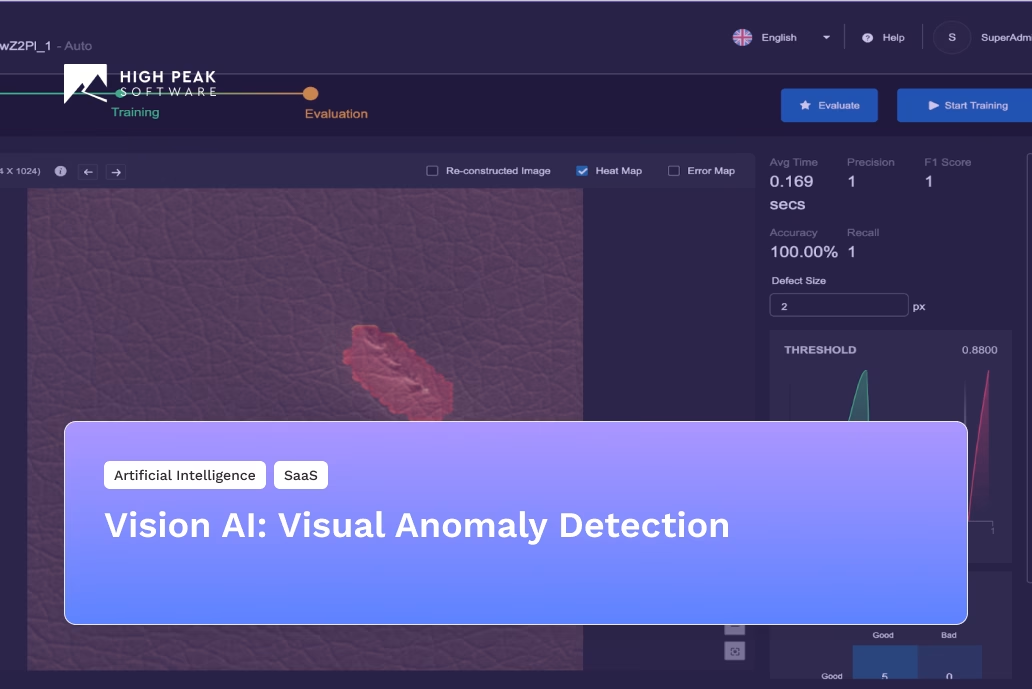
Vision AI: Visual Anomaly Detection
Vision AI is an automated surface defect detection platform based on computer vision and machine-learning algorithms....
Read More
Community Based Group Buying Ecommerce App
Did you know that pricing is a major purchasing factor in the fragmented African e-commerce market?...
Read More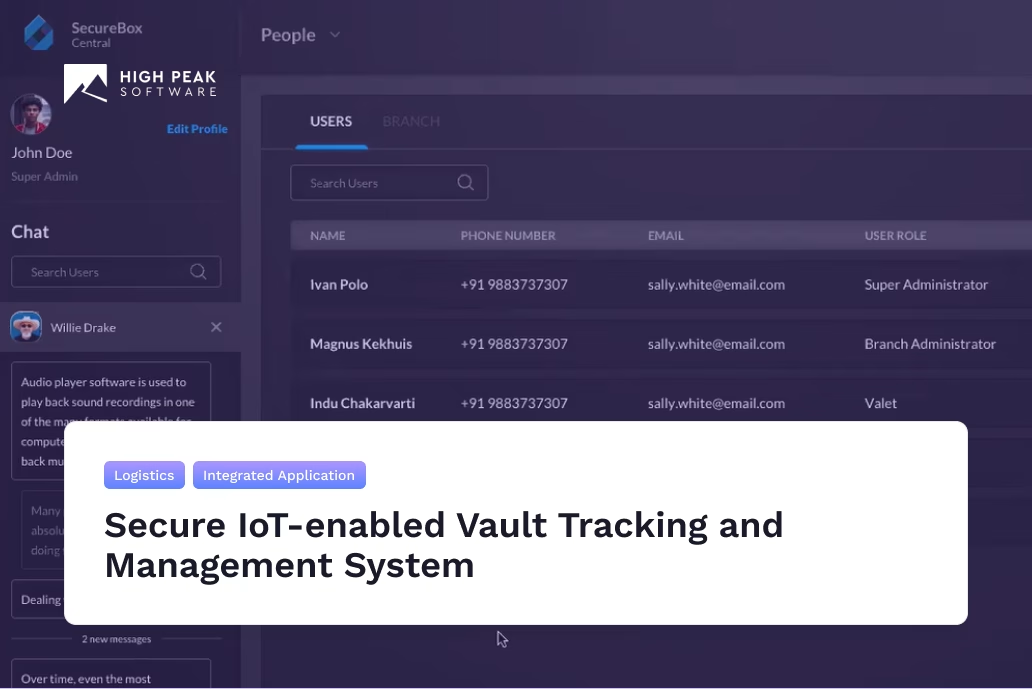
Secure IoT-enabled Vault Tracking and Management System
In the present-day market, transporting high-value assets like cash, gold, sensitive documents, or luxury goods is...
Read MoreWant to know about our
other services


Ready to Get Started?
If you are evaluating enterprise AI agents, do not start with a flashy demo and hope governance appears later. Start with a workflow worth automating, a realistic integration plan, and clear control points, then let High Peak Software turn that into a delivery roadmap. Talk with our team about discovery, architecture, or deployment support.