
Table of Contents
- What changed in intelligent document processing by 2026?
- How did IDP move from OCR to autonomous workflows?
- What makes agentic document automation different from older IDP?
- Why does 99% accuracy change everything?
- What does the real-world impact look like?
- Where is adoption happening first?
- What does an enterprise agentic IDP architecture look like?
- What should enterprises get right before implementation?
- How High Peak Software builds document AI enterprise systems that go beyond extraction
- Ready to Get Started?
- FAQ
Intelligent document processing in 2026 is no longer just about extracting text from a PDF. The category has shifted from recognition to execution, which means modern systems can read a document, reason about what it means, decide what should happen next, and trigger downstream actions with auditability built in. A recent market assessment describes an IDP landscape with more than 100 notable vendors, while a separate industry survey found that 78% of companies are already operational with AI in document workflows.
That matters because document-heavy operations sit right at the intersection of two accelerating trends: enterprise demand for better document AI and much broader adoption of autonomous systems. One recent market forecast projects the agentic AI market to grow from USD 7.06 billion to USD 93.20 billion by 2032. In practical terms, intelligent document processing 2026 is becoming a core entry point for that shift, because documents are where so many real business decisions begin.
Key Takeaways
- Agentic document automation goes beyond OCR by combining extraction, reasoning, validation, routing, and action in one workflow.
- The move from template-driven systems to high-90s accuracy changes the economics of automation because exception queues shrink fast once errors stop being constant.
- Modern document AI enterprise stacks now rely on multimodal document understanding, orchestration layers, tool use, and observability, not just OCR engines.
- BFSI is leading adoption, with one recent market forecast putting the segment at 32.7% of IDP market share in 2026, while legal workflows are also moving from experimentation toward production.
- The winning implementation strategy is not rip-and-replace. It is layered modernization that connects document AI to existing systems, controls, and human review paths.
What changed in intelligent document processing by 2026?
The short answer is this: IDP stopped being an extraction tool and became a workflow engine. Earlier systems turned images into text and fields. Agentic IDP turns documents into decisions, tasks, exceptions, and system actions. That is why terms like agentic document automation, OCR to autonomous workflows, and document AI enterprise all now point to an architectural shift, not a minor product upgrade.
That shift is visible in both product design and enterprise demand. Official multimodal document-understanding guidance now treats long PDFs as native model inputs, and newer agent-building primitives explicitly include tool use, workflow orchestration, file search, and observability. On the Microsoft side, current release notes show document intelligence maturing as an ongoing platform capability, not a one-off OCR feature.
How did IDP move from OCR to autonomous workflows?
The evolution happened in four stages. First came OCR, then template-based IDP, then AI-enhanced extraction, and now agentic IDP. Each stage removed a different bottleneck, but only the latest stage can handle multi-step reasoning and take action after reading the document.
OCR read the page
Classic OCR solved the first problem: turning scans into machine-readable text. That was useful, but it did not understand structure, context, or business meaning. It could tell you the characters on a page, not whether a number was a total, a routing code, a clause deadline, or a fraud signal.
Template IDP matched a pattern
Template-era IDP improved on OCR by mapping expected fields to fixed layouts. For structured documents with low variation, that worked well enough. But every layout change, supplier variation, new form version, or handwritten edge case created fresh maintenance work, which kept humans trapped in the loop.
AI-enhanced IDP learned the document
The next stage added machine learning, layout understanding, and semantic extraction. That is when systems started classifying documents, extracting tables, inferring fields, and coping better with semi-structured content. Recent guidance on multi-step document extraction shows this clearly: teams are now combining large models with structured external rules instead of relying only on brittle templates.
Agentic IDP executes the workflow
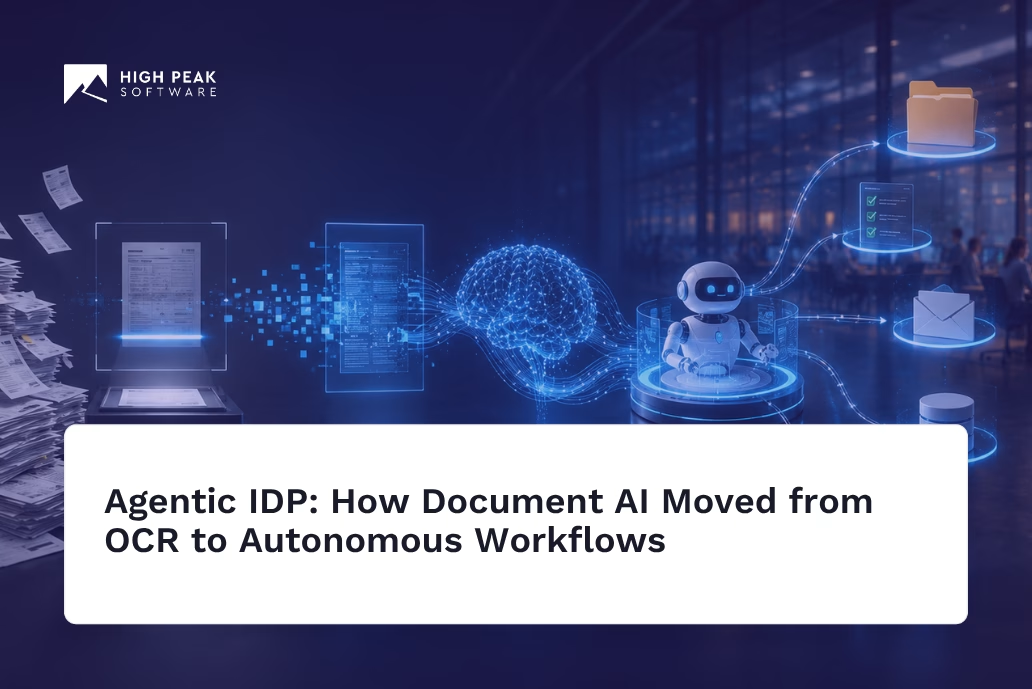
The latest stage is what makes IDP AI autonomous. The system does not stop after extraction. It evaluates confidence, cross-checks fields against business rules, calls tools, routes exceptions, requests missing information, updates systems of record, and leaves an auditable trace of what happened. That is the real meaning of OCR to autonomous workflows.
What makes agentic document automation different from older IDP?
Agentic IDP is different because it can plan and act, not just parse. Traditional systems focus on recognition and extraction. Agentic systems add reasoning, tool use, adaptive sequencing, and recovery steps when the first pass is incomplete or ambiguous.
Autonomous reasoning
A modern document pipeline can now infer what a field means from surrounding context, not just its coordinates. That matters for invoices with inconsistent layouts, contracts with nonstandard clauses, and onboarding packets where one document explains another. The model is not simply reading tokens, it is interpreting the document as part of a business process.
Multi-step workflow execution
Document handling rarely ends at extraction. Someone still has to validate the vendor, match the PO, check sanctions lists, update the ERP, generate an exception ticket, or request a missing signature. OpenAI’s current agent stack now exposes the exact primitives needed for that, including tool use, file search, orchestration, and execution tracing.
Error recovery and fallback logic
Legacy workflows usually broke hard when a field was missing or a format changed. Agentic workflows degrade more gracefully. They can retry with another parser, ask a follow-up question, send a human review request with context, or continue the workflow while isolating only the uncertain fields. That is a major reason pass-through rates improve in production, even when documents are messy.
Adaptive decision-making
The best systems do not treat every document the same. They apply different confidence thresholds, validation paths, and escalation rules by document type, customer, jurisdiction, or risk score. In other words, the workflow becomes policy-aware, not just format-aware.
Why does 99% accuracy change everything?
Because automation economics are nonlinear. When extraction accuracy lives in the 80s, humans still spend most of their time reviewing, correcting, and rekeying. When accuracy climbs into the high 90s, the work pattern flips: humans review exceptions instead of touching every document. That is the real automation tipping point. One recent market analysis frames traditional OCR on structured documents at roughly 80% to 90% accuracy versus 95% to 99% for AI-driven OCR and IDP.
Production examples show how much this matters. In one large-scale deployment, document processing was measured at 98% document-level accuracy and 99.999%+ data inference accuracy across tens of millions of documents per customer each year, with strict straight-through expectations. That does not mean every use case will hit those numbers, but it does show that the ceiling has moved far beyond what most teams associated with OCR a few years ago.
The operational consequence is simple math. At 85% accuracy, 15 out of every 100 documents need intervention. At 99% accuracy, that drops to 1 out of 100. On a monthly volume of 100,000 documents, that is the difference between 15,000 exceptions and 1,000 exceptions.
It also changes fraud and compliance workflows. Microsoft’s bank statement extraction model is explicitly positioned around extracting structured data from official statements used to detect fraud, track expenses, and surface accounting errors. That is exactly why better OCR and document understanding now feed KYC, AML, and financial review pipelines instead of sitting as a disconnected capture layer.
What does the real-world impact look like?
The biggest gains come from speed, consistency, and exception reduction. When document workflows stop waiting for manual sorting and rekeying, teams can move closer to same-day handling, cleaner downstream data, and far less rework. That matters in AP, lending, onboarding, claims, and compliance operations where queue time is often more damaging than pure extraction cost.
Recent finance benchmarking gives a useful baseline. A current accounts payable benchmark shows a median cost of $6.00 per invoice processed across a large cross-industry sample. Meanwhile, a separate AP survey found that the share of organizations processing invoices in under a week fell from 80% to 52%, while those taking more than 15 days rose from 5% to 25%. If your document workflow is still manual or semi-manual, the business case is not abstract. It is already showing up in cycle time, backlog, and supplier experience.
The headline benefit of agentic document automation is not just cheaper extraction. It is cleaner operations. Fewer touches means fewer handoff errors. Better document understanding means fewer silent data defects entering ERP, CRM, underwriting, or case systems. And when exceptions are packaged with explanations, reviewers resolve them faster because they are not starting from scratch.
Where is adoption happening first?
BFSI is leading because the sector is both document-heavy and risk-sensitive. A recent market forecast puts banking, financial services, and insurance at 32.7% of IDP market share in 2026. That is not surprising. Banking lives on statements, onboarding packets, loan files, KYC forms, claims documents, and audit trails, which makes it the natural proving ground for agentic document automation.
Financial use cases also benefit from domain-specific models. Microsoft’s current bank statement model combines OCR with deep learning to extract transaction data in structured JSON, and Google Cloud customer deployments are already setting straight-through expectations in the high 90s for large-volume document operations. That mix of volume, structure, and compliance pressure is why BFSI keeps moving first.
Legal is following fast. Recent legal-sector research says agentic systems are already being built that can research a regulation, draft a document, identify pitfalls, and revise the draft, with human stops added as needed. That is a strong signal that document processing is expanding from extraction-only tasks into end-to-end knowledge workflows.
Healthcare will keep growing as well, but usually with tighter oversight. The opportunity is enormous because intake forms, referrals, prior authorizations, EOBs, claims packets, and medical records are still full of manual bottlenecks. The difference is that implementation quality, auditability, privacy controls, and human escalation paths matter even more than raw model performance.
What does an enterprise agentic IDP architecture look like?
The modern architecture has four layers: multimodal document understanding, reasoning and validation, workflow orchestration, and enterprise integration. If one of those layers is missing, you do not have agentic IDP. You have a stronger parser, but not an autonomous workflow system.
Layer 1: multimodal document understanding
This layer ingests PDFs, scans, images, emails, and attachments, then extracts text, layout, tables, signatures, and visual cues. Current document-understanding workflows and document intelligence platforms now treat long documents and varied formats as standard inputs, which is a major leap from older OCR-only stacks.
Layer 2: reasoning and validation
This is where the system checks meaning, not just text. It compares extracted fields to schemas, business rules, master data, and adjacent documents. It can infer a missing field, spot a mismatch, or flag a document for review because the numbers reconcile poorly even though the OCR itself is technically correct.
Layer 3: workflow orchestration
This layer decides what happens next. It routes low-risk documents straight through, sends medium-confidence cases to a reviewer, requests missing documents, triggers notifications, and logs every step. The important part is that workflow sequencing is dynamic, not frozen in a hard-coded if-then tree.
Layer 4: enterprise integration
Finally, the workflow has to connect to the systems that actually run the business. That means ERP, CRM, case management, DMS, ticketing, compliance tools, and internal APIs. Without this layer, even a very smart extractor just creates another inbox.
What should enterprises get right before implementation?
Three things matter most: document quality, system integration, and governance. If you get those wrong, even a strong model underperforms. If you get them right, agentic IDP becomes far more reliable because the workflow has clean inputs, the right tools, and explicit guardrails.
First, fix upstream document quality. Poor scans, missing pages, inconsistent naming, and low-resolution files still hurt outcomes. Microsoft’s document guidance continues to stress image quality, text size, supported formats, and input constraints because better models do not eliminate bad inputs.
Second, design for layered integration. Most enterprises should not replace their ERP, policy admin, core banking, or legal systems just to modernize document handling. If you need a broader view of this pattern, our article on integrating AI into legacy systems without blowing up your roadmap explains why layered architecture usually beats rip-and-replace.
Third, build governance into the workflow itself. Documents often contain financial, contractual, or personal data, so auditability and access control are not optional. Current cloud documentation emphasizes encryption, access controls, compliance programs, regional handling, and approval workflows for support access, which is exactly the level of control enterprise teams need when moving from pilot to production.
How High Peak Software builds document AI enterprise systems that go beyond extraction
At High Peak Software, we do not treat IDP as an isolated OCR feature. We build document-centric systems that connect ingestion, extraction, review, business validation, and downstream action, which is the only way autonomous workflows become production useful.
Our own Scarlet document platform reflects that thinking. It combines automated document analysis, intelligent OCR, review workflows, and domain-specific handling across BFSI, tax, insurance, healthcare, HR, legal, and manufacturing. That foundation is exactly what enterprises need before they layer in agentic reasoning and autonomous routing.
If you want the broader context, we have already covered how AI process automation creates operational leverage, where AI workflow automation improves efficiency, and when agentic workflows make strategic sense. This article is the document-first layer of that story: how to move from extraction to action without losing control.
In practice, that means we focus on high-volume document flows where accuracy, explainability, and system integration matter at the same time. We help clients identify the right confidence thresholds, exception paths, validation rules, and system touchpoints so the output is not just structured data, but a reliable business outcome.
Ready to Get Started?
If your team is still using OCR as a glorified copy-paste engine, now is the moment to rethink the architecture. Agentic IDP is what happens when document AI becomes operational, accountable, and connected to the systems that actually run your business.
Talk with High Peak Software about building autonomous document workflows for onboarding, AP, lending, claims, legal review, or compliance operations. Start the conversation here: let’s connect.
FAQ
What is agentic IDP?
Agentic IDP is intelligent document processing that can reason about a document and act on it, not just extract fields from it. It combines document understanding with validation, orchestration, tool use, and exception handling so workflows can complete with minimal human intervention.
How is agentic document automation different from OCR?
OCR converts an image into text. Agentic document automation reads the document, interprets the context, decides what should happen next, and triggers the right business action, which might include routing, reconciliation, escalation, or system updates.
Does 99% extraction accuracy really matter that much?
Yes, because a small gain in accuracy creates a large drop in exception volume. Once you move from touching nearly every document to touching only edge cases, staffing, cycle time, and straight-through processing all improve quickly.
Which industries are adopting agentic IDP first?
BFSI is leading because it combines high document volume with high compliance pressure. Legal and healthcare are also strong fits, especially where review-heavy workflows and fragmented documents create expensive operational drag.
Do you need to replace core systems to implement document AI enterprise workflows?
No. Most companies get better results by layering document AI onto existing systems through APIs, queues, and workflow services. The goal is to modernize document handling without destabilizing the systems of record that already run the business.
